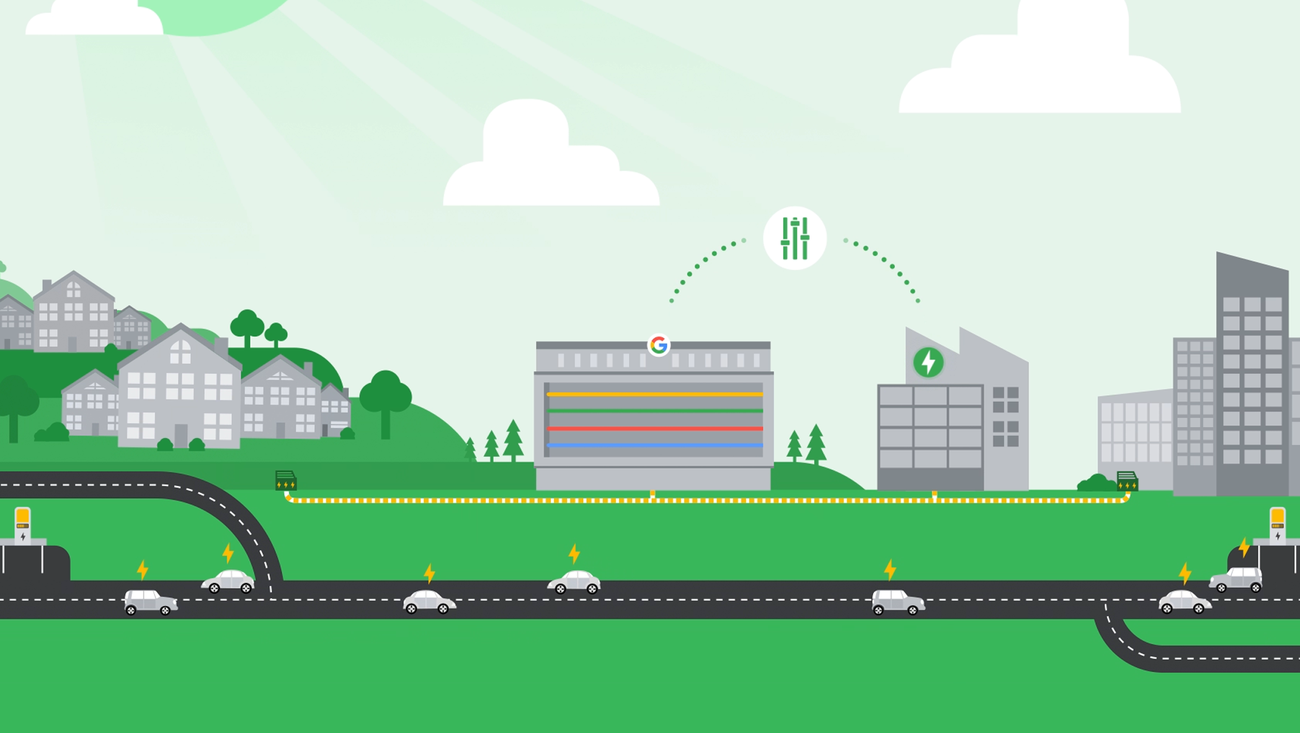
Google said on March 19, 2026 that it had integrated one gigawatt of demand-response capacity into long-term agreements with US utilities. The company’s explanation is narrower than a claim that an entire data center can simply be switched off: it describes limiting or shifting a portion of machine-learning workloads. That qualification is the most important part of the announcement for businesses building autonomous services.
An AI operation is a collection of different jobs. Some are scheduled in advance, some arrive unpredictably, and some are waiting for an external system or a person. Their deadlines differ. A useful flexibility program identifies those differences and turns them into a reliable operating commitment. It cannot be built on the word “AI” as if that described one uniform electrical load.
Moving training is different from delaying a customer
Training, evaluation and simulation can sometimes be arranged around a wider time window. Interactive inference has a user waiting at the other end. A long-running agent can contain both kinds of work: it may perform background analysis, then reach a step where a delayed response blocks a transaction or a human decision. Flexibility must therefore be assigned to tasks and stages, not merely to products.
Google’s earlier description of utility partnerships identified Indiana Michigan Power and the Tennessee Valley Authority as partners in integrating flexible demand with planning. The significance is institutional as well as technical. A utility needs a commitment it can incorporate into its operating assumptions, while a computing operator needs to know when and how that commitment can be called upon.
A reduction must be distinguishable from an idle period
If a campus happens to be quiet when the grid is under stress, low consumption alone does not prove that a flexibility program delivered a reduction. The relevant comparison is against a defensible baseline. An agreement needs a way to distinguish deliberate load management from demand that never materialized, alongside a clear record of the requested event and the operator’s response.
This matters commercially because the value of flexibility depends on being available when needed. A company cannot count the same spare capacity as insurance for its customers and as a dependable grid resource without explaining how competing claims are resolved. The most demanding test is not an easy afternoon with ample headroom. It is a grid event that coincides with strong customer demand.
Compute contracts can preserve room to move
AWS’s purchasing guide distinguishes on-demand capacity, commitments, interruptible instances and reservations for particular periods. Those are commercial arrangements rather than electricity programs, but they illustrate why workload scheduling and purchasing need to be considered together. A team can make an application technically flexible while locking itself into a contract that reduces the financial benefit of moving it.
The reverse can happen too. A team may purchase inexpensive, interruptible capacity for work that has not been designed to resume safely. In that case the lower unit price buys an operational problem. A credible flexibility strategy begins by identifying restartable stages, preserving intermediate results and knowing which tasks must remain on a stable service regardless of the immediate cost.
The energy benefit needs its own accounting
The IEA’s 2026 energy-and-AI analysis describes both rapid data-center demand growth and pressure on the physical systems supporting it. Flexibility addresses the timing and location of demand; it does not necessarily reduce the total amount of work performed. A job moved to another hour still consumes electricity, although the consequences for the grid may be different.
That distinction should be visible in reporting. A company can separately describe reduced peak demand, energy saved, emissions effects and avoided infrastructure requirements. Combining them into a single claim makes it hard to identify what the program actually achieved. The same caution applies to shifting work between regions: the receiving location has its own network, generation mix and capacity constraints.
What autonomy changes
As agents begin to schedule more of their own work, they may also become part of demand management. A system could defer a nonurgent analysis or choose an approved location with available capacity. But the permission to make that decision must be bounded by the user’s deadline, data requirements and service contract. An energy-saving choice is not useful if it violates the purpose of the task.
The opportunity is to make those boundaries explicit in software. A job could carry a deadline, an interruption policy and a list of permitted operating regions. The scheduler could then optimize within those limits and report when no acceptable option remains. This is a design proposal, not a claim that Google’s announcement already implements that complete system for every workload.
The company calls the one-gigawatt figure capacity integrated into long-term energy contracts. It is therefore a statement about contracted capability, not a claim that one gigawatt has already been withheld from the grid during every event. Reporting on the program should preserve that distinction. An operating history would add the dates on which flexibility was requested, the duration of each event and the reduction actually delivered. Such evidence would let utilities and customers judge whether the arrangements perform as intended without confusing a contract milestone with a year of measured results.
The one-gigawatt milestone is newsworthy because it puts a substantial contractual scale behind the idea of flexible computing. Its lasting importance will depend on performance during real events: how much demand changes, how reliably it changes and what happens to the work. For autonomous AI, the useful promise is not unlimited flexibility. It is flexibility that leaves the service’s obligations intact.
Sources & evidence
This archive preserves its original editorial date. Sources describe the events and announcements discussed; they do not establish today’s status.